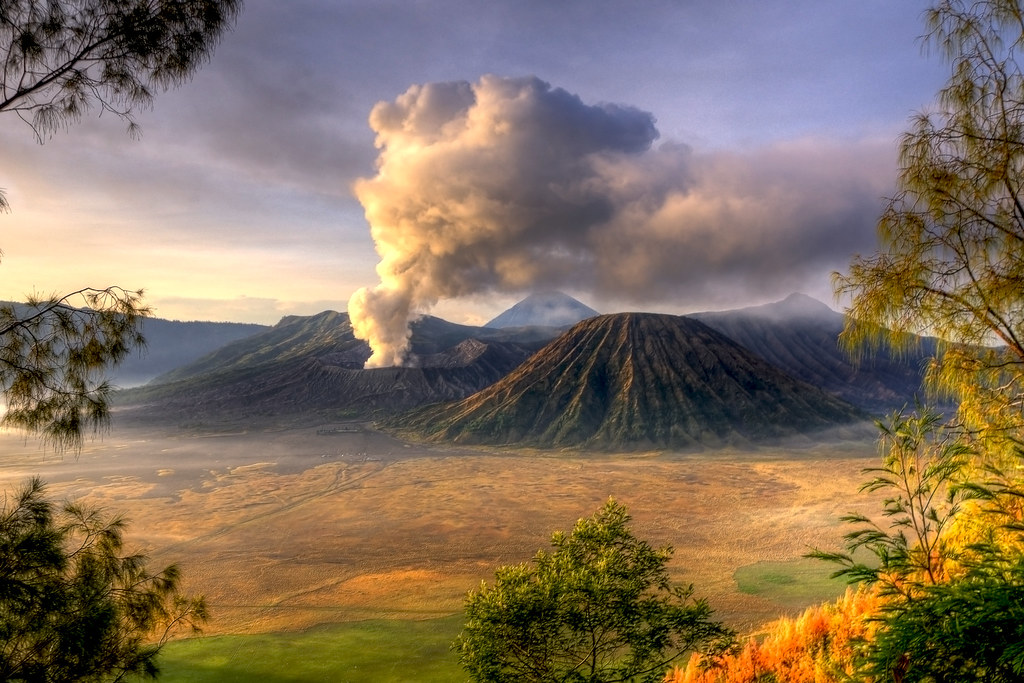
Probably the most famous volcanoes of Indonesia is situated here, upon the island of Java. Its name is Bromo and it‘s an active volcano : its crater permanently produces smoke and steam and occasional eruptions take place from time to time (the final one is at 2012 ). Simultaneously this volcano is very easily accessible : one could get the foot from the mountain by car after which climb the stairs to obtain the crater. Easier compared to the volcanoes of Kamchatka, we should say. And also the altitude from the volcano Isn‘t that high, only 2392 meters. That‘s why Bromo is among the preferred volcanoes, many tourists visit it daily.
Bromo volcano, Indonesia
Actually, four more volcanoes are situated within the Tengger caldera : besides Bromo there will be Mount Batok (2, 470 m ), Mount Kursi (2, 581 m ), Mount Watangan (2, 661 m ) and Mount Widodaren (2650 m ), but Bromo is that the only active volcano among them. Outside the area of caldera there are many more summits, Semeru (3, 676 m ) is part of them, the very best mountain of Java Island and an active volcano also.
Mist above Tengger Caldera
Our method to Bromo started inside the airport of Surabaya town. We loaded inside a bus, there was an extended journey to Bromo Tengger Semeru National Park. On our way the weather was getting worse : while outside the window the fields were changing to some serpentining mountain path, it started raining. Then inside an hour rain became a thick fog. Once we reached Bromo, we could make out only clouds of greyish mist upon the edge from the Tengger caldera. Somewhere behind them the volcano was hiding from us.
In the observation platform from the Bromo volcano
Locals convinced us that it was eventually a significant typical weather ; ‘It is usually raining inside the afternoon', they said, there was an opportunity the fog would dissolve allowing us to discover Bromo. Meanwhile the rain was getting stronger and We‘re not encouraged in the least. But whatever the weather, we agreed to descend towards the caldera.
It was eventually dark once we left. Comparing to the warmth of Yogyakarta and Jakarta, We‘re quite pleased to have the mountain coolness initially. But very soon this cold began to chill our bones. Old but reliable Land Cruiser was carrying us over the sector of hardened lava. With his teeth chattering towards the rhythm from the motor, our driver was shivering and wrapping inside a blanket. I‘d been trying to obtain a sense of how he managed to locate an open road during this fog, but in vain : all of the directions during this greyish haze seemed as being same for myself. But soon we saw the silhouette of the temple : we reached the place.
Pura Luhur Poten Temple
Hindu Temple of Pura Luhur Poten was built from the local inhabitants and it is situated right in the foot of Bromo. The temple is rather humble, it‘s possible to say even ascetic. Once a year the holiday of Yadnya Kasada, which lasts for any month, happens here. In the celebration, people make certain sacrifices : they throw rice, fruits, vegetables, flowers, even poultry along side small cattle straight into the crater in an effort to propitiate the sleeping forces from the volcano. But regardless of the sacrifices, the volcano awakes once in a few years. Lava traces upon the slopes from the mountain will be the remainders of the activity.
The caldera's bottom all around the volcano is covered with ashes, practically no plants could be found here. Black waves of ashes create dunes. This place is the ‘Sand Sea'. No wonder : the sand was easily stepping into our shoes.
Bromo volcano, Indonesia
Actually, four more volcanoes are situated within the Tengger caldera : besides Bromo there will be Mount Batok (2, 470 m ), Mount Kursi (2, 581 m ), Mount Watangan (2, 661 m ) and Mount Widodaren (2650 m ), but Bromo is that the only active volcano among them. Outside the area of caldera there are many more summits, Semeru (3, 676 m ) is part of them, the very best mountain of Java Island and an active volcano also.
Mist above Tengger Caldera
Our method to Bromo started inside the airport of Surabaya town. We loaded inside a bus, there was an extended journey to Bromo Tengger Semeru National Park. On our way the weather was getting worse : while outside the window the fields were changing to some serpentining mountain path, it started raining. Then inside an hour rain became a thick fog. Once we reached Bromo, we could make out only clouds of greyish mist upon the edge from the Tengger caldera. Somewhere behind them the volcano was hiding from us.
In the observation platform from the Bromo volcano
Locals convinced us that it was eventually a significant typical weather ; ‘It is usually raining inside the afternoon', they said, there was an opportunity the fog would dissolve allowing us to discover Bromo. Meanwhile the rain was getting stronger and We‘re not encouraged in the least. But whatever the weather, we agreed to descend towards the caldera.
It was eventually dark once we left. Comparing to the warmth of Yogyakarta and Jakarta, We‘re quite pleased to have the mountain coolness initially. But very soon this cold began to chill our bones. Old but reliable Land Cruiser was carrying us over the sector of hardened lava. With his teeth chattering towards the rhythm from the motor, our driver was shivering and wrapping inside a blanket. I‘d been trying to obtain a sense of how he managed to locate an open road during this fog, but in vain : all of the directions during this greyish haze seemed as being same for myself. But soon we saw the silhouette of the temple : we reached the place.
Pura Luhur Poten Temple
Hindu Temple of Pura Luhur Poten was built from the local inhabitants and it is situated right in the foot of Bromo. The temple is rather humble, it‘s possible to say even ascetic. Once a year the holiday of Yadnya Kasada, which lasts for any month, happens here. In the celebration, people make certain sacrifices : they throw rice, fruits, vegetables, flowers, even poultry along side small cattle straight into the crater in an effort to propitiate the sleeping forces from the volcano. But regardless of the sacrifices, the volcano awakes once in a few years. Lava traces upon the slopes from the mountain will be the remainders of the activity.
The caldera's bottom all around the volcano is covered with ashes, practically no plants could be found here. Black waves of ashes create dunes. This place is the ‘Sand Sea'. No wonder : the sand was easily stepping into our shoes.

Tidak ada komentar:
Posting Komentar